
Memory
The judgment should stay with the file.
MindLab turns reviewed research, monitoring signals, reports, and decisions into governed context the firm can reuse. Sources, assumptions, objections, and approval state stay available after the memo, report, or portfolio update is done.
Firm Memory
Knowledge
17Search approved firm memory
Firm Core & Strategy
Investment mandate, operating cadence, approved firm context.
Scoring & Output Standards
Rubric logic, IC memo standard, reusable report rules.
IC & Approval Workflow
Decision memos, draft-versus-approved states, reviewer gates.
Sector Research & Theses
Accepted sector theses and supporting market context.
Portfolio Memory
Approved company history, assumptions, and monitoring playbooks.
Document Permissions
Source boundaries, access rules, and workflow constraints.
Rejected-Deal Lessons
Pass logic and reusable warnings from declined opportunities.
Valuation Support
Accounting, audit, valuation, and support-context standards.
Governance & Permissions
Team roster, partner preferences, and external-safe knowledge.
Pipeline & Flow
Deal stages, triage conventions, and sourcing context.
Fund & LP Reporting
Fund, LP, and family-office reporting examples.
Portfolio Operations
Operating playbooks and value-creation memory.
Memory is governed context, not a file dump.
Rubrics, approval workflows, sector theses, portfolio memory, and pass logic become reusable only after the firm has accepted them.
Accepted context
Only reviewed material becomes reusable firm memory.
State preserved
Draft, challenged, approved, and external-safe knowledge stay separate.
Routed on demand
Rubrics and prior judgment return when the next workflow needs them.
Technical Substance
Memory is useful only when it has state.
Retrieval alone finds files. Investment teams need to know where a claim came from, what changed, who reviewed it, whether it was accepted, and whether it can be used again.
Research intelligence
Decks, PDFs, models, transcripts, updates, public research, monitoring signals, and prior memos become structured material the system can inspect.
Claim lineage
Important claims can carry source references, missing-information markers, contradictions, confidence behavior, and review flags.
Firm memory
Approved assumptions, decisions, risks, scoring context, reviewer notes, reports, monitoring history, and company history become reusable context.
Context routing
MindLab decides which sources, memory, permissions, and review rules should reach the model for a specific task.
Permission boundary
Internal knowledge, approved records, advisor answers, and external-safe outputs remain governed by different rules.
Memory in Use
Future reports should start from what the firm already approved.
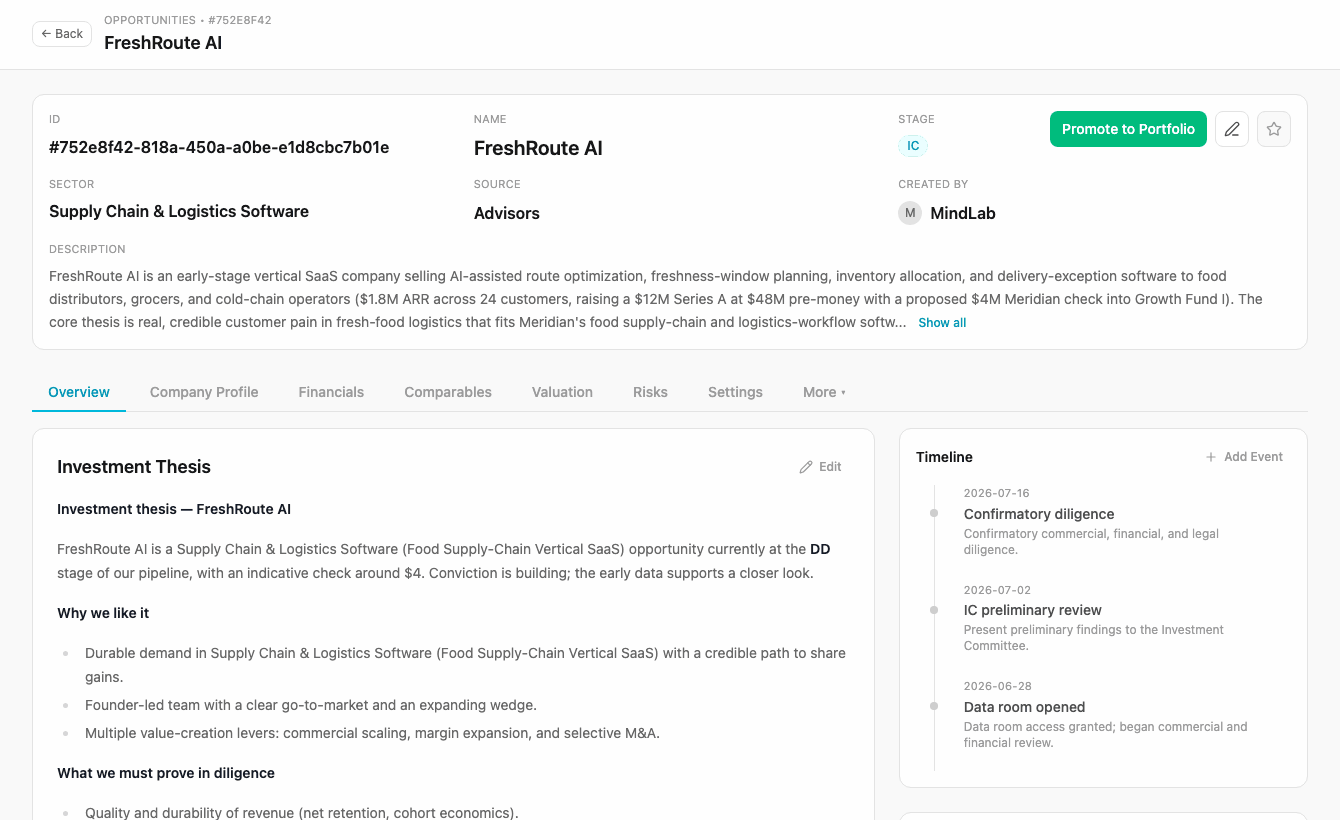
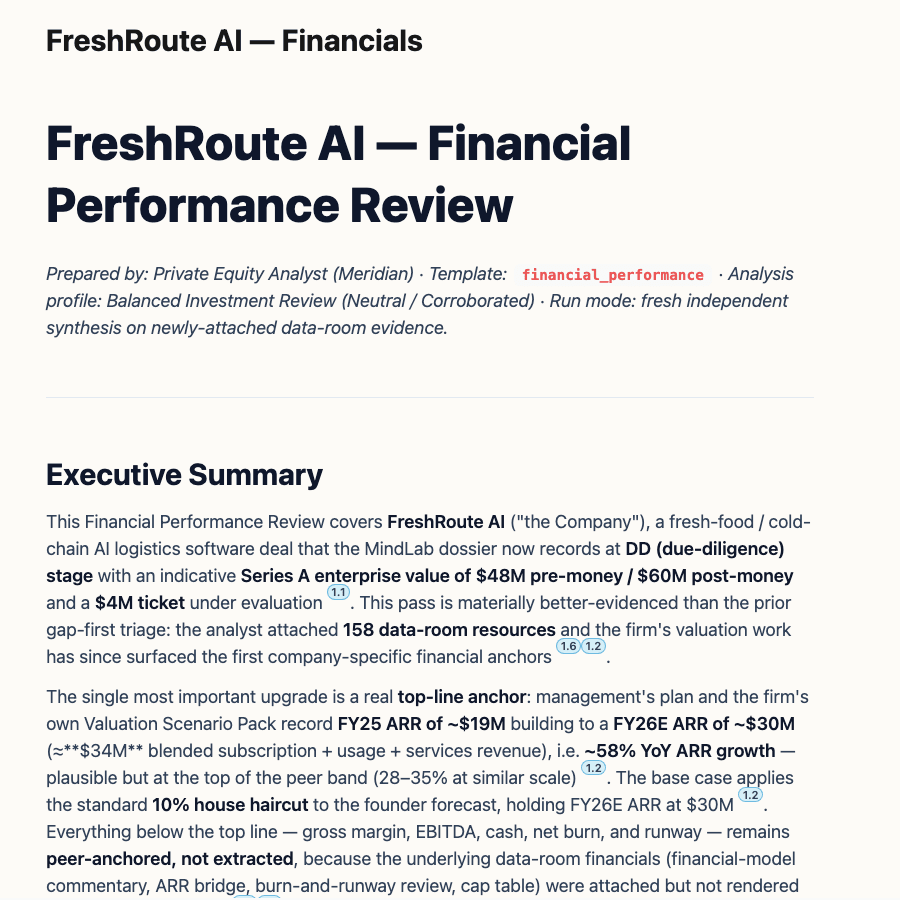
FreshRoute AI is a fictional sample company built with non-client sample data.
What Memory Preserves
The record is useful only if it preserves judgment, not just documents.
01
A claim is challenged
The reviewer edits the language, keeps the source marker, and marks the weaker claim as rejected.
02
A market signal changes
Radar ties the signal to affected companies, open reports, and approved assumptions that may need review.
03
A company update arrives
MindLab compares new metrics against prior approved assumptions and flags drift.
04
An advisor asks a question
The response can use approved facts while internal valuation debate stays blocked.
05
A similar deal appears later
The prior pass logic, rubric, source trail, and reviewer objection can be routed into the new workflow.
Principles
This is why MindLab is more than a workflow tool.
Memory is not a file dump. It is accepted context with state.
The firm decides what becomes reusable.
Draft work, approved work, and external-safe knowledge are different states.
Every workflow should leave the next workflow with better context.
Next Step
See how approved work becomes reusable memory.
On a demo call, we can show how research intake, radar signals, source lineage, approval state, permission boundaries, and company memory work before implementation is scoped.